
by Diana Castro-Vazquez
Every year, a guest speaker gives a Schleunes lecture at Greensboro College. Professor Doris Bergen gave this year’s lecture. The lecture is presented through the generosity of Richard and Jane Levy of Greensboro in honor of the late Holocaust scholar Dr. Karl Schleunes of the University of North Carolina of Greensboro.
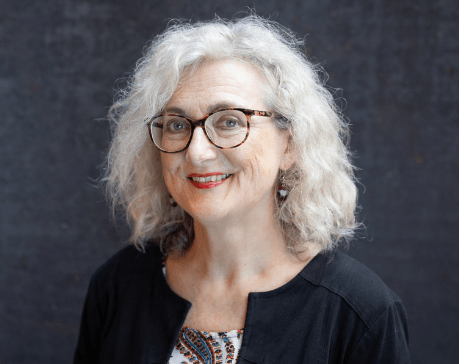
Professor Bergen is the Chancellor Rose and Ray Wolfe Professor of Holocaust Studies at the University of Toronto. She is the J.B. and Maurice C. Shapiro Senior Scholar in Residence at the United States Holocaust Memorial Museum in Washington, D.C. Her research focuses on issues of religion, gender and ethnicity in the Holocaust and World War II. She has written many books, including “Twisted Cross: The German Christian Movement in the Third Reich,” “War and Genocide: A Concise History of the Holocaust” and “The Sword of the Lord: Military Chaplains from the First to the Twenty-First Centuries and Lessons and Legacies VIII.” She also has ongoing projects, including a study and a new book. The study is of definitions of Germanness as revealed in the Volksdeutschen-ethnic Germans of Eastern Europe during World War II and the Holocaust. The book is about German military chaplains in the Nazi era.
To open the lecture, Greensboro College President Dr Lawrence Czarda remarked, “Tonight is such an occasion as the research and analysis of our speaker follows in the footsteps of such distinguished thinkers as Hannah Arendt, Viktor Frankl, Stanley Milgram, Steven Katz, Philip Lombardo… and many more. 15 years, all in their way, adding to our understanding of how seemingly ordinary events in an established culture can lead to organizations and people committing unspeakably heinous acts, war crimes, crimes against God and man,” Czarda said. “As an important aspect of our intellectual Heritage at Greensboro College in our 185th year and indeed the liberal arts, traditionally, it is the willingness to tackle difficult subjects and ponder deep questions of who we are, how we interact and how we deal with the constantly challenging and changing world around us. Greensboro College remains committed to its relationship with scholarly studies of the Holocaust and genocide and is honored to have named this lecture series after noted historian teacher the late Karl Schleunes.” This opening statement made by Dr. Czarda is a direct reflection of how Greensboro College views the Holocaust and the importance of talking about these subjects.
Professor Bergen had many points, her main topic being “Were the Nazis Christian?” She started by mentioning the Israeli–Palestinian conflict, “I want to say at the outset that I am trying with this talk and with all the work that I am doing in this field, to hold open an understanding of the study and the commemoration of the Holocaust that hears the cries of people everywhere who are suffering, that hears the cries of the victims of the Hamas attacks of October 7, that hears the cries of children and their families in Gaza, that hears the cries of people in our own communities who are suffering.”
Bergen wanted to explain what was distinctive about the Nazi assault on the Jews. She mentioned that violence is not something out of this world. Violence is engraved into our societies. She argued that there are many misconceptions around the topic of Nazis’ Christianity. She started with an anecdote. She used to teach at the University of Notre Dame, and during one of her classes about the Holocaust, a student asked, “What religion was Hitler?” One student guessed Jewish, but historians do not believe this is true. Hitler was born and raised a Roman Catholic and never denied his religion. So, the answer to the question, “were the Nazis Christian?” is yes.
She continued with another question, “Were the Nazi perpetrators Christian?… Almost two-thirds of the population was Protestant, about one-third Catholic, a very small percentage… less than 1% of the population was Jewish and 4% were other.” She went on to explain that Nazis were Christians because Germans were. This can be tracked because of documentation; members of Catholic and Protestant churches paid church taxes.
Nazis were also Christians culturally, “Christianity shaped German society: the holidays, the rituals of daily life, the names, the kind of rhythms of birth, marriage, burial and so on.” In public, Hitler also performed his piety- reverence for God or devout fulfillment of religious obligation- which added to his legitimacy. Nazism was not another branch or form of Christianity, instead, Nazi ideology used Christian theology such as anti-Jewish imagery, which was adapted for its own purposes. Bergen showed two illustrations, “Those two illustrations both come from a very famous Nazi children’s book ‘The Poisonous Mushroom’ and you can see in the one image with the mother and the children the use of the old lie that Jews killed Jesus. Here, it is being repurposed as an antisemitic slogan of Jews as the enemies of the German people. The other image showing the man and the woman coming out of the church with the caption ‘baptism
did not make them into non-Jew,’ of course, takes the Nazi notion that Judaism was in the blood ineradicable and turns it into a sexual threat, right? You could see the way the male character is cast lecherously looking at the two women, and the woman character is also interestingly cast looking lecherously at the priest. The Catholic priest again using the notion of the church and somehow the idea of Jews infiltrating, bringing that Christian scene into Nazi purposes.”
Professor Bergen gave a couple more examples to back up her take on Nazis being Christians. Overall, her lecture was very insightful, and it was one that I enjoyed listening to. I would highly recommend listening to the lecture on YouTube titled, “The 15th Annual Schleunes Lecture on the Holocaust and Genocide” on the Religious Life YouTube Channel. There will be another Schleunes Lecture next year, so be on the lookout!
 The Collegian