
By Shaniah Taylor
Greensboro is perfectly situated between two of North Carolina’s most prominent cities, so it may be hard to believe that there is a deep and rich history that lies just down the street. This Black History Month, The Collegian invites you to explore a historical trail you may have never known about.
Every Greensboro resident is familiar with the city’s two Historically Black Colleges and Universities (HBCUs): North Carolina Agriculture & Technical State University (NC A&T) and Bennett College. These schools have long been pillars of the civil rights movement in Greensboro, largely through the courage of The Greensboro Four and the Bennett Belles.
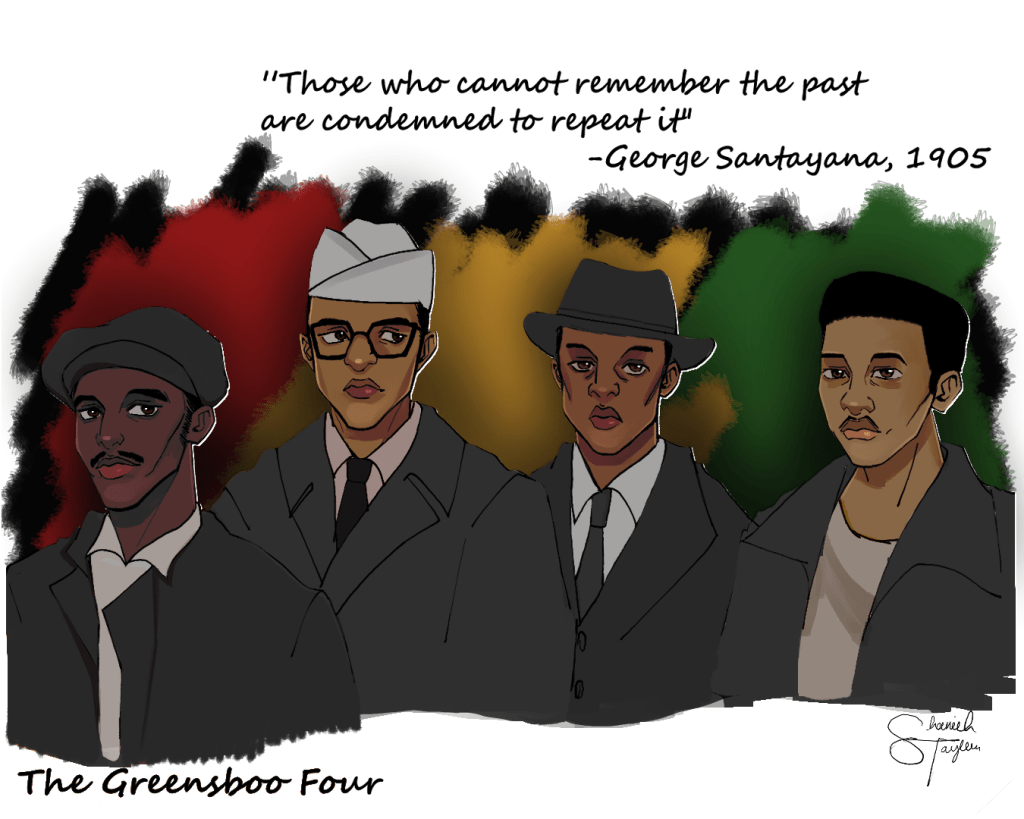
In late 1959, the Bennett Belles organized a plan to stage a sit-in at a whites-only lunch counter. However, they recognized that at the time it was dangerous to have women head this movement so they supported the Greensboro Four in starting the protest. On Feb. 1, 1960, Ezell Blair Jr., David Richmond, Franklin McCain and Joseph McNeil made history at the Woolworth’s lunch counter. Following this act Bennett students joined the protest as planned. Around 250 arrests were made, but the momentum would eventually lead to desegregation in July 1960.
Though not often in the spotlight, the Bennett Belles have always been instrumental in Greensboro’s social justice efforts. For example, in 1938 they picketed the Carolina Theater for cutting scenes out of movies that portrayed African Americans positively. Along with a few other protests against how African Americans were treated in the film industry, this was monumental as African American roles were almost never combatted publicly. Black actors had to be the butler, maid, mammy or Uncle Tom with no further argument.
Linda Brown, a Bennett Belle who participated in the 1960s sit-ins, later wrote “Belles of Liberty: Gender, Bennett College and the Civil Rights Movement,” a book documenting the strategic planning behind the protests. Few may also know that when Martin Luther King Jr. struggled to find a place to speak in Greensboro in 1958, Bennett College President Willa B. Player offered him a spot at Bennett, declaring: “Bennett is a liberal arts college where freedom rings, so Martin Luther King Jr. can speak here.” This was one of two times he would come to Bennett – the second one being in 1960 – here he spoke on “creative protest” emphasizing nonviolence and selfhood. The full hour-long talk is available on YouTube.
Greensboro is also home to the Greensboro Six – Dr. George Simkins, Leon Wolfe, Joseph Sturdivant, Samuel Murray, Elijah Herring and Phillip Cook – men who defied segregation by golfing at the whites-only Gillespie Park Golf Course on Dec. 7, 1955, just six days after the arrest of Rosa Parks. They were arrested, charged with trespassing and jailed for 15 days. This courageous act contributed to the broader civil rights movement and after a lengthy legal battle – even though the case was lost by the supreme court – the course was forced to desegregate. In 2024, a mural was painted at the course to honor them.
Knowing the legacies of NC A&T and Bennett College it is no surprise that so much history unfolded within their campuses, producing notable alumni like Justice Henry and Shirley Frye, the first black Assistant U.S. District Attorney and first black person appointed to the N.C. Supreme Court and his wife, who was a civil rights leader and continues to support her community today. There is also of course the late great Rev. Jesse Jackson who graduated from NC A&T and was a protégé of Martin Luther King Jr. and James Bevel during the civil rights movement.
Despite these institutions’ greatness, history also lives at two schools Greensboro does not mention often: Guilford College and our own Greensboro College. Guilford College is home to Guilford Woods, an old-growth forest that once offered refuge to enslaved Africans seeking freedom via the Underground Railroad. And on your way to PHE and PHW, you will pass a mural at Greensboro College honoring Penny Nichols, class of ’73, the first African American to graduate from the institution.
As you leave campus take a moment to notice the history around you. Warnersville, recognized in 2015 as Greensboro’s first Heritage Community, was the city’s first planned African-American community in the 1870s. L. Richardson Memorial Hospital, opened in 1927, was the first modern African American hospital in Greensboro, serving Black patients during the Jim Crow era. James B. Dudley High School, founded in 1929, was the first Black high school in Guilford County. South Benbow Road, a historically Black neighborhood, is listed on the National Register of Historic Places. And the East White Oak Community Center, built in 1916, allowed children of Black Cone Mills employees to study while their parents worked.
These landmarks are more than just hospitals, community centers and museums. They are reminders of Greensboro’s greatness that shaped the civil rights movement and more. This Black History Month, take the time to walk this trail and reflect on the history that lives here.
 The Collegian