
By David Slifer
A lot has been happening within the last few years involving the entertainment industry. Much is being added on to that pile with Warner Bros Discovery. Warner has been dealing with debt since the early 2010s, and it has been worse since the beginning of this decade. Many projects they had been working on and had finished were cancelled so that they could later be made as tax write-offs. Some of these projects were the Batgirl film with Michael Keaton as Batman, the Wile E. Coyote movie starring John Cena and many others.
Many companies were involved in the bid with Paramount/Skydance, Netflix and Universal Studios were the biggest names in the bid. Even Saudi government at one point put their dog in the fight. The general public was very adamant though that they hoped Paramount would not win as President Trump was involved in making bids for the company.
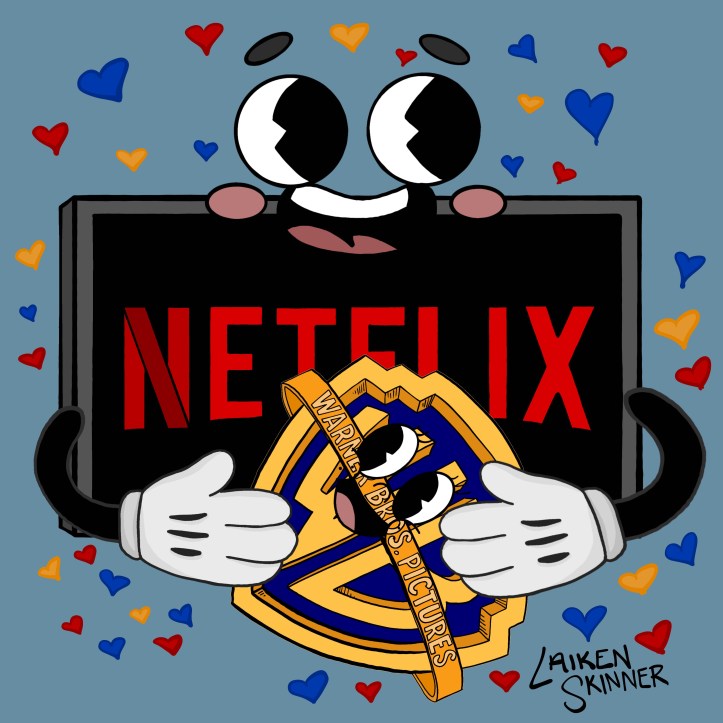
The biggest two contenders though were Paramount and Netflix. When this was all going down before Warner decided to go with Netflix, the public was not really happy about anyone buying the company as they believed Paramount would be very hostile and controlling of the properties. With Netflix they thought that any new Warner project would be released to streaming immediately. Netflix’s plan though doesn’t seem bad for its consumers. Warner’s streaming service HBO Max will continue to stay up with Netflix saying they have no intention of shutting it down if they are to purchase. With that said, Warner projects making their way to Netflix is a possibility. A big worry many had was the release of projects straight to streaming. Netflix has said that they plan to theatrically release Warner films on a 45-day window. To compare that, both 2025 films “Sinners” and “Superman” had a shorter theatrical run. Netflix does not intend to make extreme changes to the consumer. The worry for its workers though should be talked about.
The Collegian got to talk with Greensboro College’s AJ Schraeder and his thoughts on the entire situation. From his perspective, we got to understand what this will entail for the creatives/writers in this industry. We first asked about his initial reaction to the news.
“My initial reaction was honestly, ‘Oof,’” he said. “It felt like a major consolidation of power in the entertainment industry, and historically that is rarely great news for writers. Immediately after that I thought about friends of mine in major markets who make their living as staff writers, and I found myself worried about how this kind of consolidation could affect their opportunities and job security.”
This opened our eyes as the perspective that many have viewed was the public and not the people who will be actively affected by the purchase.
“I do not see it as a positive right now,” Schraeder said of the direction this takes the industry. “The business side often frames consolidation as an opportunity for efficiency, but on the creative side, fewer decision-makers usually means fewer opportunities. Even executives with the best intentions can only filter decisions through their own experiences, which inevitably leads to some level of homogeneity. That can be especially damaging for writers early in their careers, who are afforded less room for risk-taking and fewer alternative paths forward. If someone does not vibe with your creative output, there are simply fewer places to turn. The more homogenized our creative landscape becomes, the easier it is to repeat the same stories over and over again instead of actively searching for new ones.”
“In addition to what I mentioned previously, the Disney–Fox merger from not long ago adds real weight to these concerns,” he said about his personal worries. “In that case, we saw a pivot away from traditional writers’ rooms toward mini-rooms, which resulted in fewer weeks of pay and a major disruption to the development process. Writers were often spending significant amounts of time on shows that never went to air, which drastically reduced residuals. The job landscape for writers is already far less secure than in most industries. There is no guarantee of being brought back season to season, so residual pay becomes a survival issue rather than a bonus. Consolidation tends to accelerate these dynamics rather than alleviate them.”
With how that purchase changed the writers’ room and process, it is understandable the worry that could grow bigger in that aspect as they could grow worse. Going deeper into the changes of the writing process, he later talked about things he thinks will happen.
“I think the worry is that streaming will continue moving toward models that give companies more flexibility at the expense of stability for workers,” Schraeder said. “That means more project-based work, fewer long-term commitments and less continuity from season to season. The 2023 writers’ strike had a number of causes, but this trend was a major motivator behind that dispute. It becomes an even greater concern in this case, given that it involves the company with the largest share of the streaming market.”
For Schraeder, his concerns don’t lie with which company will get the final deal.
“I think the specific bidder matters less than the broader pattern. Whether it is Paramount, Netflix or anyone else, continued consolidation raises the same concerns about fewer opportunities for writers and creators. A head of state backing one purchase over another muddies the regulatory framework if it is not paired with clear reasoning that explains how an alternative merger would better protect the public from trust and antitrust issues. Ultimately, my concern is not about who wins the bid so much as what another major consolidation would mean for creative stability.”
With how the entertainment industry has been for the past few years with the strikes and now this, it is easier to see why people are so worried about this change. For the people who are working in this industry the struggle is hard as the limits and restraints begin to only grow tighter. In my eyes, something like this you have to see both sides, but the concern is a must to look at. The company is not sold, but the way it is looking right now, Netflix will own Warner Bros Discovery.
 The Collegian