
By Riley Blankenship and Lane Bumgarner
When the Gaza cease-fire was announced in October, headlines from across the world wanted to frame it as this long-awaited end to a devastating conflict. But merely weeks later, it was back to disarray with strikes and unrest. Families in Palestine were just beginning to return to what was left of their homes. For a brief moment we saw what a sense of relief it was — children back at home, aid trucks moving again, and people hoping that the worst had passed. But that calm did not last at all.
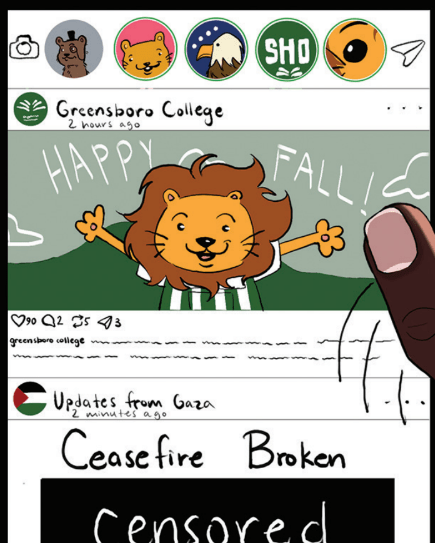
Now that the ceasefire has been broken, this has raised questions that echo beyond the Middle East, including on many college campuses like Greensboro College. What does peace really mean if it never lasts?
To go in deeper, the Collegian sat down and spoke with professors along with students regarding the broken ceasefire, moreover how this uncovers the intricacy and delicacy of peace, the powers that diplomacy has, and just how global conflicts such as this shape our very understanding of conflicts in small academic communities like here at Greensboro College.
The Collegian had the opportunity to sit down and speak with the Political Science Department Chair Dr. Altan Atamer. When asked why he personally believes ceasefires such as the Gaza conflict always seem to break down, he believes power that nations hold is a big and important reason that ceasefire always break down.
“We know for instance that the U.S. is a big supporter of Israel, we also know that the U.S holds veto power in the U.N. and as a result of this there really has not been any if much pressure directed towards Israel.” However, Atamer did note there is domestic pressure such as protests, but that is more directed regarding bringing hostages home.
A huge question that has arisen through all the conflict: What exactly can college students learn from watching how the ceasefire has unfolded? Atamer believes finding a ceasefire is not simply made by just a piece of paper saying, “Hey stop fighting.” It is far more complex, with both parties involved making efforts to stop and find diplomacy.
“Because it is not going to be determined by a piece of paper that says to stop fighting, that is not the reality of the situation. It is just something to be wary of even if a war ends on paper. It does not really end either though,” Atamer stated.
He brought examples such as back in 2021 when President Biden stated that we had pulled out of Afghanistan; however, the U.S continues to still use drones in Afghanistan. He also brought the example of recently the U.S. shooting random ships out in the waters of the Pacific.
I believe another major question that has been on both students’ minds but society in general: How should we even define peace if it is just going to be broken? When asked regarding this, Atamer explained that Palestinians oftentimes have little influence in the peace process itself.
“Palestine does not have much of a say in how peace is structured,” he said. “It is almost a modern version of the old League of Nations mandate system where foreign guarantors act as proxies for a Palestinian voice. That runs against the whole idea of self-determination.”
He went on to question the legitimacy of outside powers shaping the region’s future. “It feels strange that foreign committees and alliances dictate who is or is not the rightful community. That is not to excuse Hamas’s violence or its terrorist designation, but you can’t expect peace to emerge from external arrangements from a kind of Trump-Blair style alliance that decide how Palestine should be governed.”
The Collegian had the opportunity as well to speak with History professor Dr. Allison Palmadessa. When asked if she thought there were any specific moments in history that seem to resemble the Gaza ceasefire, she went as far as the 1990s and in 1991 with war on the Middle East, the Desert Storm and the war on terror.
“It would seem like there would be a point where things would just ease and then they didn’t and actually took a lot longer,” Palmadessa stated.
On seeing how the Gaza ceasefire has just blown up, one might ask with these past ceasefires what can we learn from them exactly? Palmadessa answered that question by pointing out how hard it is to make clear comparisons.
“We do not ever have the full story,” she said. “And right now, unfortunately, I think that is especially true. It is hard to make judgments about the challenges of the current ceasefire when there’s a media war happening when so much of what we know is through how governments and administrations choose to put information forward.”
The Collegian also sat with Greensboro College students to discuss their perspective on the war. While responses and beliefs varied, the consensus was the importance of community. When asked how perspective in media may have shifted throughout the Middle Eastern conflict, game design and English double major Madison Stokes said, “It shows heavy censorship in the type of government we have. It also shows how important it is to use our first amendment to right and that there is importance in community involvement. The government does not discuss the war, the community does.”
Music education major Jayda Howell adds that this war may be teetering the lines of a modern-day Vietnam. “The government hides stuff, but the media allows us to see what’s really going on. We would not know how bad it was if it weren’t for the online communities being used to show the extent of what’s really going on.”
When asked how this situation can be tied back to college students, the community remained the number one response. “We are a community, and we need to use our education to form our own opinions outside of what mainstream news tells us to think,” states an anonymous student. The same student also adds that our government is not the only power source in America; we, the people, have more standing power than we believe.
Adding to this, free thinking was another interesting point brought up by all interviewees. Another anonymous student claims that “free thinking is more important now than ever.” In response to how division online can create misinformation among American youth about the war, the student believes that “you have two extremes with very opposite takes on what is happening or should happen, and that can lead to heavily skewed information to make one side seem more reliable. Students these days rely solely on broadcast news and may not know what is going on or may only know through social media. I think that is another reason we don’t see a lot of support from people in our age range.”
As we report about this issue from a small campus, this conflict raises dozens of questions and how they matter significantly. Through the voices of both students along with professors, there is one main thing that stands out from the rest — that being peace is not just a single movement; moreover, it is a process, one in which that demands so much from honesty, perception, moreover the willingness to keep asking hard questions even when the answers are not clear.
 The Collegian