
By Shaniah Taylor

East or the library recently, you may have seen them. Spotted winged creatures, perched atop nearby vegetation. You may have thought they were moths, butterflies or you simply had not thought about them at all. But that creature – the spotted lanternfly – has not only taken over vegetation on campus, they are a nuisance causing trouble far beyond the confines of Greensboro College.
The spotted lanternfly is an invasive species first detected in Berks County, Pa., in 2014. Over the years, it has spread throughout the U.S. to over 20 states according to the North Carolina Department of Agriculture and Consumer Services (NCDA&CS.) In North Carolina, the first live population of these pests was found in Forsyth County near the border of Guilford County in June 2022. They have since spread quickly to at least seven counties, including our home, Guilford County.
Many people do not think invasive species affect their daily lives, but you may be alarmed to hear that areas with these pests can also be riddled with stinging insects like wasps, and mold that can spread to buildings. The spotted lanternfly produces large amounts of honeydew when feeding. According to the NCDA&CS, “This buildup of honeydew attracts stinging insects like wasps and ants and can cause black sooty mold to grow on infested plants as well as homes and businesses.”
Unfortunately, they are known pests to over 70 species of plants including grapes, stone fruits, apples, maple, walnut, willow, chinaberry and tree-of-heaven. The tree-of-heaven is notable because it is prolific in this area. It is itself an invasive species and provides an ideal environment for the insects to feed, mate and lay their eggs.
Having these plants near our parking lots is particularly concerning, as according to NC State Extension Forestry, spotted lanternflies are known to hitchhike on vehicles and can survive high-speed travel. One of these plants is touching a parked car – meaning the driver could be carrying around an invasive species without even knowing it.
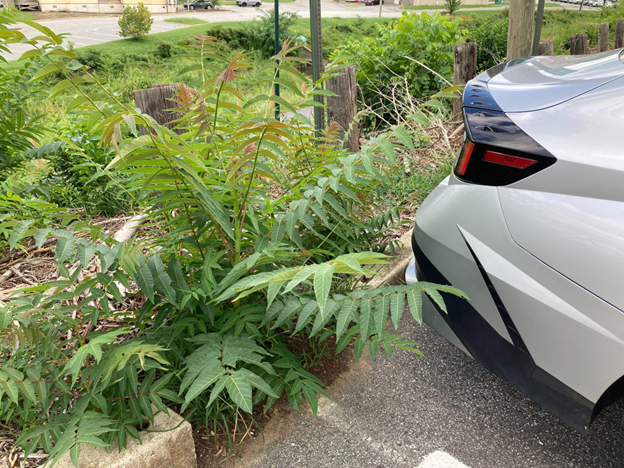
It is important to check that a spotted lanternfly is not trying to hitch a free ride before getting in your car, as stopping the spread is the only way to solve this problem once and for all.
Our campus is already doing its part to limit the spotted lanternfly’s access to parked cars. GC’s Head of Facilities Cliff Craven has been trying to control the tree-of-heaven population with herbicides all summer. Rather than encouraging students to rip plants out of the ground, the NCDA&CS advises we do our part to stop the population from spreading any further by stomping or squishing the insects and scraping any spotted egg masses into a container of rubbing alcohol to prevent them from hatching.
If you are not sure what to look for, follow this guide:
Adult insects are about one inch long with grayish wings featuring black spots and black speckles at the tips. When their wings are open, you can see bright red hindwings with black spots.
Egg masses are grayish brown, putty-like patches about 1–1.5 inches long that can be found on tree trunks, vehicles and other smooth surfaces. They may look like dried mud.
Nymphs, or young lanternflies, are black with white spots. Later nymph stages develop red patches.
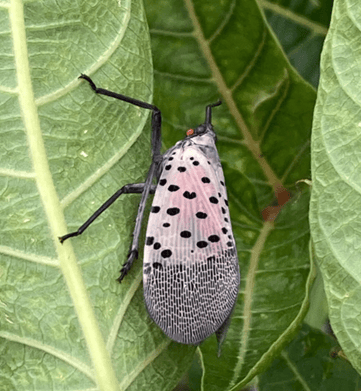
The spotted lanternfly poses a serious threat to North Carolina’s agricultural economy because of how many of our native plants the insects feed on. According to the article “Spotted lanternfly spreads to North Carolina commercial winery” by Kathan Gandhi, North Carolina’s wine industry alone generated approximately $7.7 billion for the local economy in 2025.
Just last month, in July 2026, a commercial vineyard in Davidson County became the first in the state to confirm a reproducing population of spotted lanternflies, demonstrating that the pest is no longer confined to forests and urban landscapes. In the article, Lorena Lopez, assistant professor with NC Extension, stated, “If you have bunches already closer to harvest, that is gonna ruin your bunch. If you are making wine, that can change the flavor of your wine.”
As spotted lanternfly populations continue to establish themselves across North Carolina, awareness and vigilance will be key to minimizing their impact. A few seconds of inspection could help prevent this invasive pest from reaching new areas and threatening the state’s agricultural industries.

